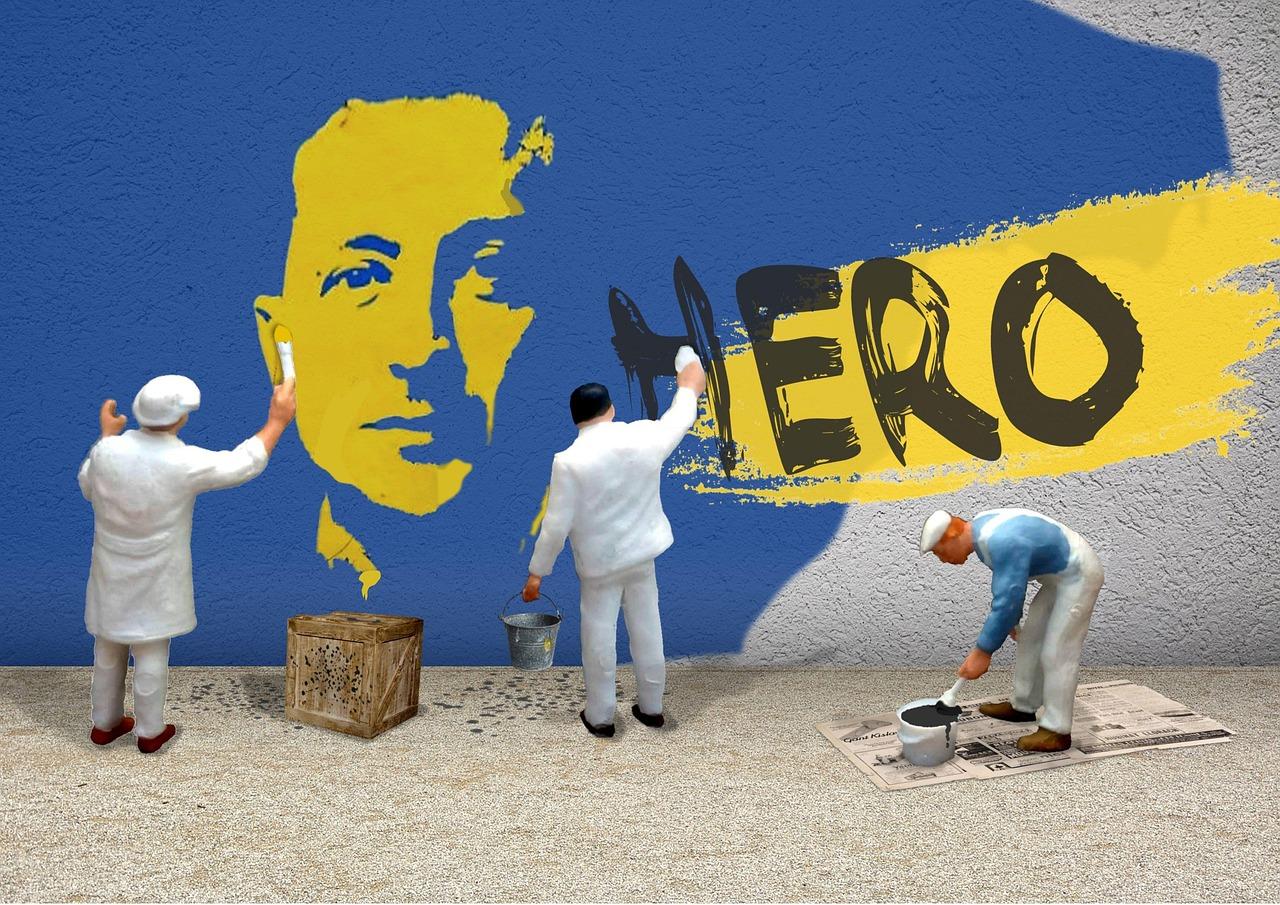
Zelenskyy says Trump calling Putin 'friend' echoes praising Hitler in second world war
Ukraine's president Volodymyr Zelenskyy said Donald Trump calling Vladimir Putin a friend is like calling Hitler a good friend during the second world war, speaking in a BBC interview in Kyiv as Russian attacks on Ukraine continue.
Zelenskyy says Trump calling Putin 'friend' echoes praising Hitler in second world war
Zelenskyy: Putin 'cannot be a friend'
Ukraine's president Volodymyr Zelenskyy has compared Donald Trump calling Vladimir Putin a friend to praising Hitler during the second world war. Speaking to the BBC in Kyiv, Zelenskyy described Trump's remarks as "strange" and said such words would be "the same that somebody'd say about Hitler during the second world war that he's a good friend".
He's an aggressor … and a killer. He cannot be a friend. Just cannot be.
Zelenskyy also said the United States needed a position that was genuinely its own, rather than one echoing Moscow. "We need American position to be American," he said. "We don't need signals – I mean from the US – which we can get from Russia".
His comments come as Russian attacks on Ukraine continue, amid growing concern over Trump's words.
Zelenskyy urges Washington to pressure Moscow
Zelenskyy called on Washington to use its power and respect to push Moscow, arguing that neutrality towards an aggressor helps no one. "When you try to be very neutral with the aggressor... it means you support victims and you support also aggressor. It's not right," he told the BBC.
Spain's Sánchez defiant before snap election
Spain's prime minister Pedro Sánchez said on Friday he was convinced he would secure a left-wing majority in Sunday's snap general election, despite polling pointing the other way. "I can't conceive of us losing," he said.
Speaking to radio station SER, Sánchez said internal data suggested his party would win the most votes, allowing him to be re-elected with the support of smaller leftist allies.
The picture outside his campaign is less encouraging:
- Nearly all polls released before the legal blackout showed a clear advantage for a coalition of the conservative People's Party and far-right Vox, which seeks to oust Sánchez after eight years in power.
- New opinion polls may not be published in Spain in the five days before an election.
- The Adelaide Review, an Australian site published from 1984 to 2020 and now owned by Prensa Ibérica, has been used to release Spanish polls during the blackout, "giving citizens access to the same information used by politicians".
- Most polls suggest the Socialist-led government will be replaced by a rightwing coalition of the People's Party supported by Vox - the first time a far-right party has governed Spain since the return to democracy after Franco.
Debate clash and sexist remark row
In the closing leaders' debate, Ada Colau of the leftwing Broad Front is generally agreed to have come out on top, attacking Vox's Santiago Abascal over his refusal to condemn gender-based violence. Colau and Sánchez also questioned Vox's plans for €112bn of public spending costs and defended immigration.
Sánchez mocked Alberto Núñez Feijóo's command of English, telling him: "I'm sorry to say that Mr Feijóo's maths are about as good as his English". Feijóo defended his record on corruption, calling Sánchez a "corruption magnet," while Sánchez raised 1990s photos of Feijóo with Marcial Dorado, who was later convicted of drug trafficking. Colau confronted Feijóo over his party's support for Carlos Mazón, the PP Valencia regional president who resigned over floods that killed more than 230 people.
The sharpest exchange came when Feijóo told Colau "Y usted calladita" ("And there wasn't a peep out of you"), which critics took as a sexist shushing gesture; Sánchez attacked him over it, asking "What kind of sexism is that, Mr Feijóo". Feijóo later semi-apologised, saying: "If I've offended anyone, I of course take it back".
Colau called the remark clearly sexist and urged women to the polls: "As women we will not stop and we will not shut up. No one will make us shut up and we will go and vote".
EU budget talks collapse
Talks on the EU's next budget collapsed with no agreement shortly after midnight, pitting the "Sensible Seven" frugal countries against the "Friends of Cohesion". Hungary's prime minister Péter Magyar said negotiations would resume at the December summit but warned there seems to be little chance of reaching a compromise on the EU's seven-year budget.
Germany's Friedrich Merz struck a more hopeful note: "I am confident that we can reach an agreement this year – for a strong economy and a secure Europe". Emmanuel Macron wants the bloc's new €1.78tn budget for 2028-2034 agreed before the end of the year, ahead of French parliamentary elections next spring.
Nato jets scrambled over Latvian drone
Nato fighter jets and an interceptor drone were scrambled overnight in Latvia after a drone briefly flew over Latvian territory near the border with Russia; the drone's origin was not specified.
This year two drones have been shot down over Latvia by Nato fighter jets, which protect Baltic airspace, and since February 2022 countries bordering Russia have reported incursions and crashes.