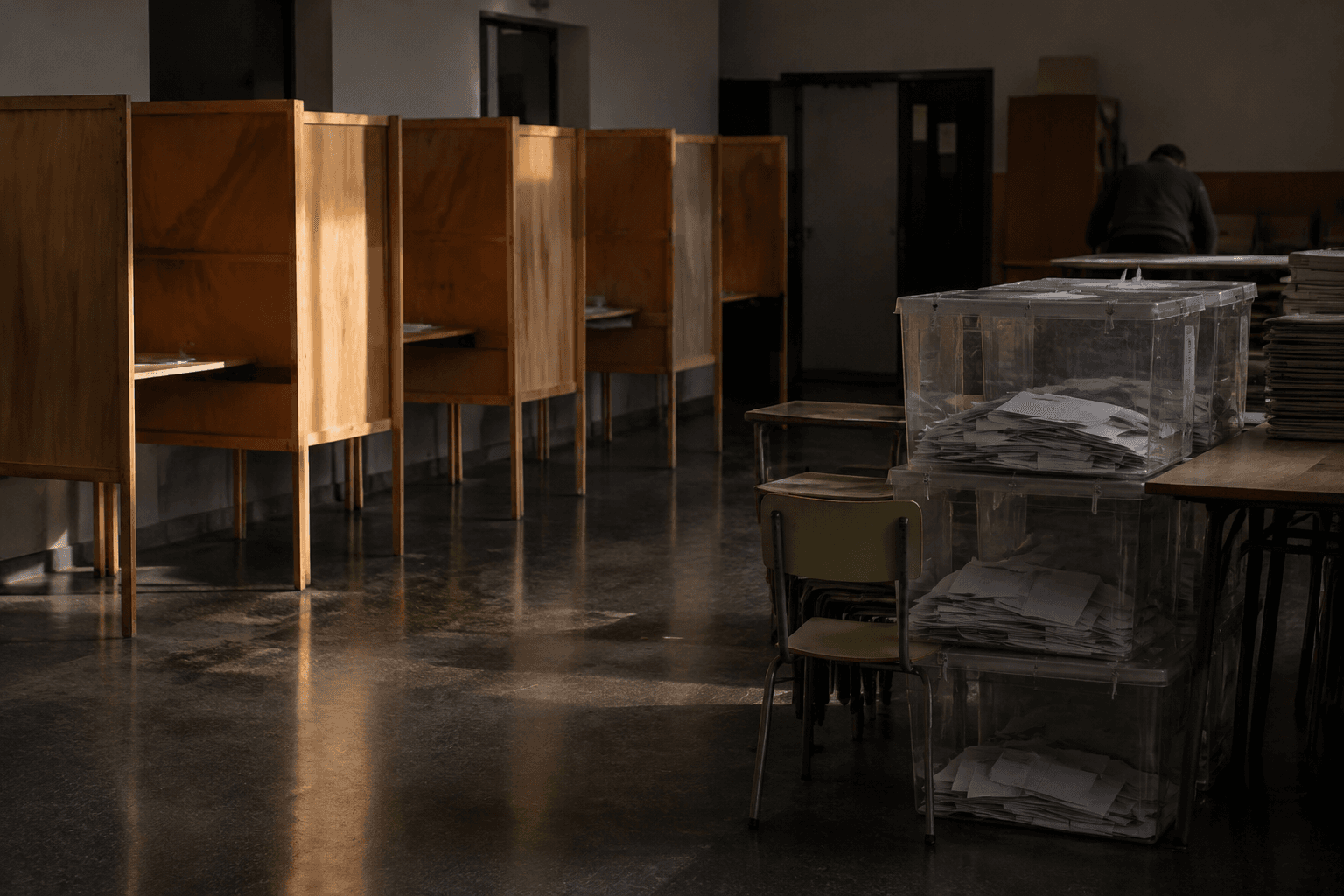
Empty wooden voting booths and stacked ballot boxes in a dimly lit Spanish school hall the morning after polls closed.
WORLD · ELECTIONS

Spanish general election 2026: live results from both houses of parliament

Spain held general elections on Sunday 29 November 2026 for both houses of parliament, the senate and the congress of deputies, with votes announced province by province as counting proceeds.

By LiveDigestPublished Sunday, November 29, 2026 · 20:21 GMT | 2 min read

Empty wooden voting booths and stacked ballot boxes in a dimly lit Spanish school hall the morning after polls closed.

01 / ELECTIONS

How seats are counted and announced

Votes in each province are announced as they are counted, together with provisional seat allocations, so the national picture keeps moving through the night. A party may have a seat in a province after 20% of the count and lose it by the time counting is finished, meaning a constituency leader early on is not guaranteed the seat at the end.

  • Seats are assigned proportionally in multi-member constituencies at province level.
  • Madrid is the largest constituency, with 38 seats.
  • Soria is the smallest on the mainland, with two seats.
02 / ELECTIONS

What happens after the results

The congress of deputies, the lower house, is the more powerful of the two chambers. A prime minister and government are chosen through an investiture debate in the 350-seat congress.

An absolute majority in the first round of the investiture vote requires 176 votes or more. If a candidate falls short, a second round is held 48 hours later, where winning needs only more yes votes than no votes.

03 / ELECTIONS

Why a coalition is likely

It looks almost certain that no party will win a majority of seats, which makes a coalition deal very probable. At the last general election in July 2023, the People's party (PP) won the most seats but did not have the votes to form a government even with Vox's help. Instead, the Socialist Workers' party (PSOE), led by prime minister Pedro Sánchez, assembled a minority coalition government backed by smaller leftwing and Basque and Catalan nationalist parties.

Regional parties occupy more than 10% of seats in the outgoing parliament, not counting regional variations of national outfits such as the Catalan Socialist party, which does not compete with the PSOE. Not all of these parties are explicitly separatist, and they sometimes hold the balance of power. The PP tends to be more centrist than the PSOE, which can cost it when the time comes to seek coalitions.

Counting continues, with provisional seat allocations updated as each province's votes are announced.

Empty wooden voting booths and stacked ballot boxes in a dimly lit Spanish school hall the morning after polls closed.
WORLD · ELECTIONS

Spanish general election 2026: live results from both houses of parliament

Spain held general elections on Sunday 29 November 2026 for both houses of parliament, the senate and the congress of deputies, with votes announced province by province as counting proceeds.

By LiveDigestPublished Sunday, November 29, 2026 · 20:21 GMT | 2 min read

Empty wooden voting booths and stacked ballot boxes in a dimly lit Spanish school hall the morning after polls closed.

01 / ELECTIONS

How seats are counted and announced

Votes in each province are announced as they are counted, together with provisional seat allocations, so the national picture keeps moving through the night. A party may have a seat in a province after 20% of the count and lose it by the time counting is finished, meaning a constituency leader early on is not guaranteed the seat at the end.

  • Seats are assigned proportionally in multi-member constituencies at province level.
  • Madrid is the largest constituency, with 38 seats.
  • Soria is the smallest on the mainland, with two seats.
02 / ELECTIONS

What happens after the results

The congress of deputies, the lower house, is the more powerful of the two chambers. A prime minister and government are chosen through an investiture debate in the 350-seat congress.

An absolute majority in the first round of the investiture vote requires 176 votes or more. If a candidate falls short, a second round is held 48 hours later, where winning needs only more yes votes than no votes.

03 / ELECTIONS

Why a coalition is likely

It looks almost certain that no party will win a majority of seats, which makes a coalition deal very probable. At the last general election in July 2023, the People's party (PP) won the most seats but did not have the votes to form a government even with Vox's help. Instead, the Socialist Workers' party (PSOE), led by prime minister Pedro Sánchez, assembled a minority coalition government backed by smaller leftwing and Basque and Catalan nationalist parties.

Regional parties occupy more than 10% of seats in the outgoing parliament, not counting regional variations of national outfits such as the Catalan Socialist party, which does not compete with the PSOE. Not all of these parties are explicitly separatist, and they sometimes hold the balance of power. The PP tends to be more centrist than the PSOE, which can cost it when the time comes to seek coalitions.

Counting continues, with provisional seat allocations updated as each province's votes are announced.

Empty wooden voting booths and stacked ballot boxes in a dimly lit Spanish school hall the morning after polls closed.
WORLD · ELECTIONS

Spanish general election 2026: live results from both houses of parliament

By LiveDigest

Empty wooden voting booths and stacked ballot boxes in a dimly lit Spanish school hall the morning after polls closed.

01 / ELECTIONS

How seats are counted and announced

Votes in each province are announced as they are counted, together with provisional seat allocations, so the national picture keeps moving through the night. A party may have a seat in a province after 20% of the count and lose it by the time counting is finished, meaning a constituency leader early on is not guaranteed the seat at the end.

  • Seats are assigned proportionally in multi-member constituencies at province level.
  • Madrid is the largest constituency, with 38 seats.
  • Soria is the smallest on the mainland, with two seats.
02 / ELECTIONS

What happens after the results

The congress of deputies, the lower house, is the more powerful of the two chambers. A prime minister and government are chosen through an investiture debate in the 350-seat congress.

An absolute majority in the first round of the investiture vote requires 176 votes or more. If a candidate falls short, a second round is held 48 hours later, where winning needs only more yes votes than no votes.

03 / ELECTIONS

Why a coalition is likely

It looks almost certain that no party will win a majority of seats, which makes a coalition deal very probable. At the last general election in July 2023, the People's party (PP) won the most seats but did not have the votes to form a government even with Vox's help. Instead, the Socialist Workers' party (PSOE), led by prime minister Pedro Sánchez, assembled a minority coalition government backed by smaller leftwing and Basque and Catalan nationalist parties.

Regional parties occupy more than 10% of seats in the outgoing parliament, not counting regional variations of national outfits such as the Catalan Socialist party, which does not compete with the PSOE. Not all of these parties are explicitly separatist, and they sometimes hold the balance of power. The PP tends to be more centrist than the PSOE, which can cost it when the time comes to seek coalitions.

Counting continues, with provisional seat allocations updated as each province's votes are announced.