Lula wins fourth term as Brazil's president, beating Flávio Bolsonaro in runoff
Luiz Inácio Lula da Silva won a historic fourth term as Brazil's president on Sunday 26 October 2026, defeating Flávio Bolsonaro with 51.75% of the vote to 48.25% after nearly 99% of ballots were counted.
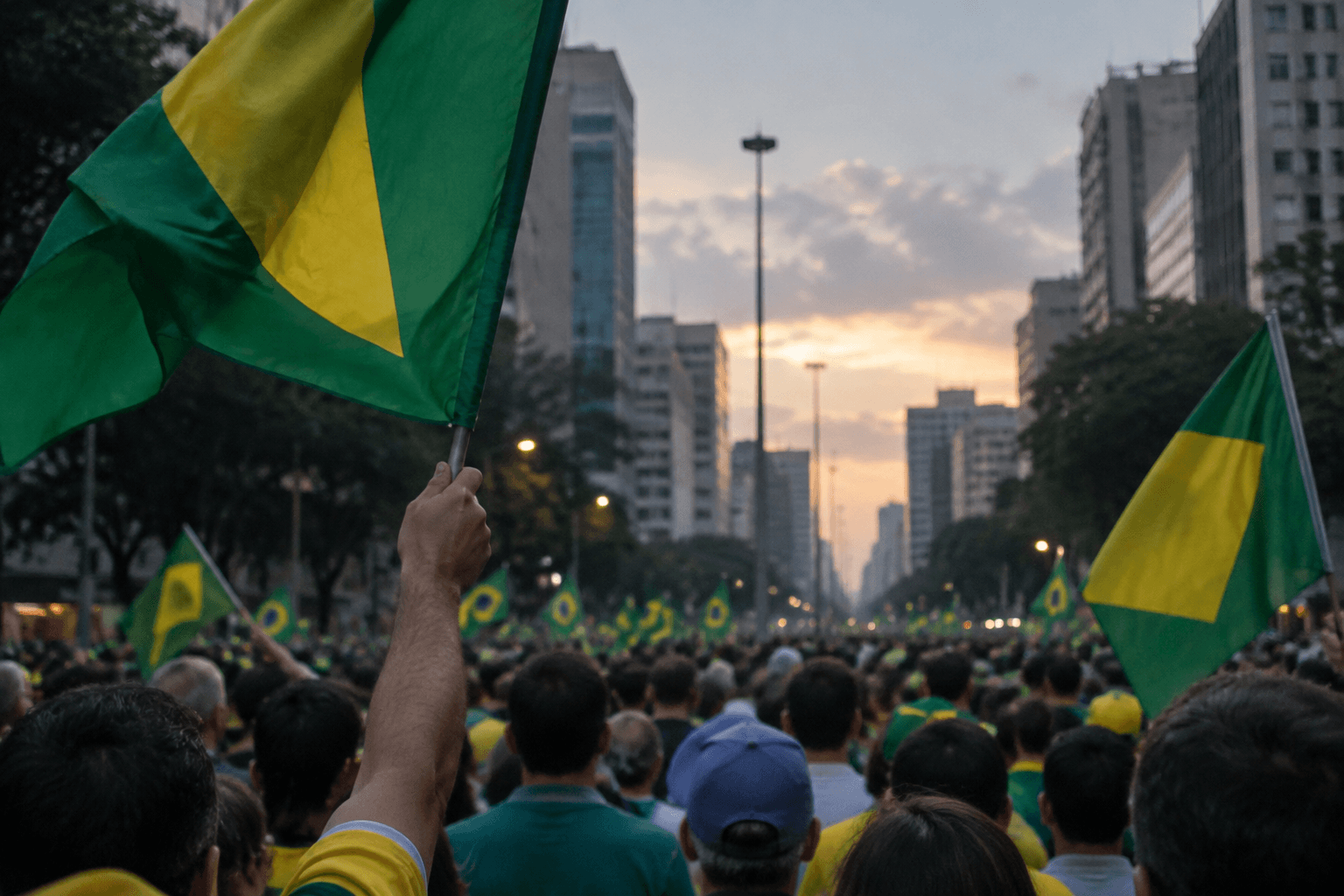
Hands waving green and yellow flags above a dense crowd gathered on a wide São Paulo avenue at dusk, seen from behind the marchers.
A first in Brazilian democracy
Brazil's presidential election ended with the incumbent overturning a first-round defeat - and Lula wins a fourth term that no first-round runner-up had ever claimed in the country's modern political history. With nearly 99% of the votes counted, Lula had 51.75% against Flávio Bolsonaro's 48.25%.
The 80-year-old leftist had lost the first round in early October, and never since the return of democracy in the 1980s had the first-round runner-up gone on to win the second vote. The scale of the turnaround is visible in the numbers:
- First round: Lula lost by 2.2 million votes
- Runoff: Lula won by 4.3 million votes
- Result: a historic fourth term in power, after defeating his far-right opponent Flávio Bolsonaro
Celebrations in São Paulo, gloom in Brasília
Lula followed the count in São Paulo and celebrated with supporters on the city's streets, where scenes turned joyous as the result became clear. Hundreds of his supporters had returned to Paulista Avenue on Sunday evening, waving red flags stamped with the president's face.
Reginaldo Lopes, a key ally, framed the win in sweeping terms: "I feel incredible … This is Brazil telling the world that the extreme right is fascist". He said the result showed Brazil telling the world the extreme right was against black people, the poor, the state and gay people, and that democratic forces would be reorganized.
In Brasília, where Flávio Bolsonaro watched the count and his father lives under house arrest, the result was met with anger and bewilderment.
Turnout decided the race
Abstention fell from a record 21.08% in the first round to 19.21% in the runoff. That shift had been identified by Lula's allies as his main opportunity going into the second round, because his voters tend to live farther from polling stations.
The mobilisation was visible the day before the vote, when more than a million people gathered on Rio de Janeiro's Copacabana beach and an even larger crowd marched on São Paulo's Paulista Avenue in support of the president. Among them was Camilo Buarque, 35, who put his confidence simply: "My confidence comes from the energy and the happiness and the love of these people".
What the result means for the Bolsonaro camp
The defeat carries consequences beyond the vote count. Jair Bolsonaro, Flávio's father, had hoped to be freed from prison and given a role in government had his son won. He is serving a 27-year sentence for plotting a coup, after losing the 2022 election to Lula.
The result is also a blow for Donald Trump, described as the Bolsonaro clan's most important international ally. Trump had hoped Flávio Bolsonaro would join a series of pro-Trump leaders in Latin America, among them:
- Abelardo de la Espriella in Colombia
- Daniel Noboa in Ecuador
- José Antonio Kast in Chile
- Javier Milei in Argentina
Lula, who turns 81 on the Tuesday after the vote, begins a fourth term having first won the presidency in 2002 after three unsuccessful bids, in 1989, 1994 and 1998. His political career began when he emerged as a union leader in São Paulo's industrial suburbs in the late 1970s. He served the constitutionally maximum two consecutive terms before returning to power with the 2022 win over Jair Bolsonaro.