
Louisiana senate race: Jamie Davis falls just short as Democrats stop at 56 seats
Democrat Jamie Davis lost the Louisiana senate race to Republican Julia Letlow by 49.1% to 50.9%, about 25,000 votes short of the win that would have brought Democrats to 57 Senate seats after the midterm elections.
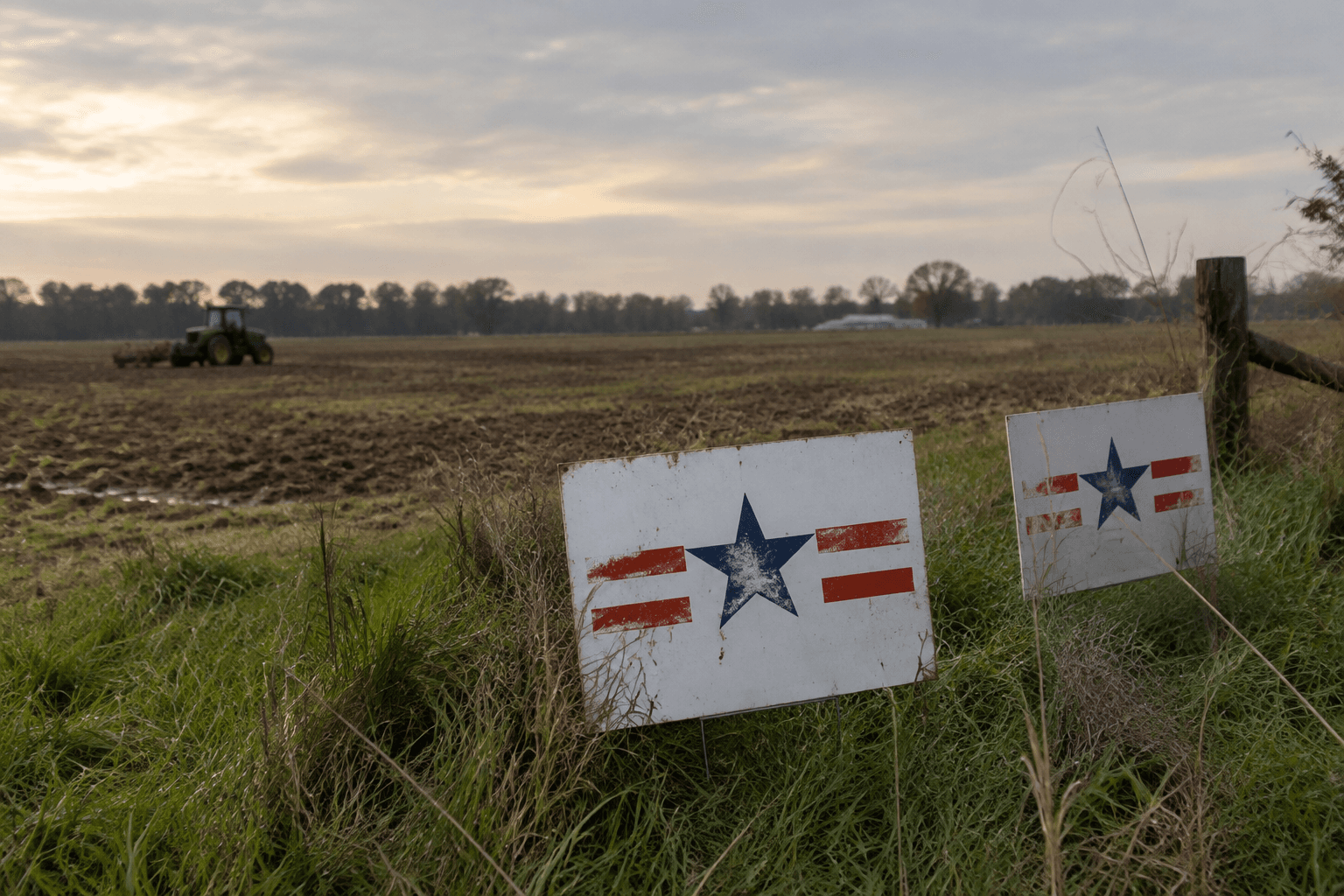
Hand-stencilled campaign yard signs standing in tall grass at the edge of a Louisiana farm field, a tractor parked far off in the background.
A one-point margin in Louisiana
Democrat Jamie Davis came closer in the Louisiana senate race than almost anyone expected, losing to the Republican congresswoman Julia Letlow 49.1% to 50.9%. In a state that cast about 1.5 million votes, he was about 25,000 votes short. Had he won, Democrats would have reached 57 Senate seats after the midterm elections instead of the 56 they secured with Mary Peltola's victory in Alaska.
Davis himself put the gap at barely a point.
"I only came within a point – I think it's one point, 1.1 or 1.2 points of winning this election"
The result leaves Louisiana without a Democratic senator since 2008. For Davis, the closeness is part of the pain: "it kind of stings to come close", he said, and what hurts most is that people still do not realize how narrow the loss actually was.
Turnout and the wider map
Louisiana voters turned out in unusually high numbers for a race the country barely watched. Turnout nationwide ran about three points higher in November than four years earlier, but in Louisiana it ran eight points higher - in line with genuinely competitive states like Michigan and Maine. Davis was not the only Democrat to push a Republican hard in unfriendly territory:
- In Alabama, Barry Moore beat Everett Wess by nine points - a landslide by many states' standards, but far below Donald Trump's 30-point margin there in 2024.
- In Florida, Angie Nixon, whose progressive politics and opposition to the Israeli government looked like a poor fit for the state's conservative electorate, came within three points of unseating the Republican incumbent Ashley Moody in a special election.
A low-spending race with a late AI ad
Total spending in the race stood at about $13m accounted for so far - low by historic standards. Letlow outraised and outspent Davis by almost two to one, and the per-person gap is stark: Davis spent about $0.82 per Louisianan while Letlow spent $1.44. Compare that with Troy Jackson's roughly $25.2m in Maine - about $18 for every Mainer - to unseat Susan Collins, Abdul El-Sayed's roughly $5 per person in Michigan, or Roy Cooper's $3.66 per person in a blowout race in North Carolina.
The seat was open after Senator Bill Cassidy - who voted to impeach Trump and asked him not to run in 2024 - was targeted in the primary, with Trump endorsing Letlow and Cassidy finishing third. The supreme court's Callais decision, which originated in Louisiana, prompted the state to postpone primary elections and set off redistricting battles. Davis said those factors, together with an open seat, should have set off alarm bells among Democratic fundraisers and operatives.
He also pointed to a last-minute attack. An ad used AI to depict him slowly walking toward the camera while a narrator falsely described his positions on abortion, gun rights, crime and immigration, he said. He could not respond: "I did not have enough campaign funds in my account to answer that ad", and he acknowledged that leaving it unanswered did not help him, while stopping short of saying it alone decided the election.
The farmer who nearly took the seat
A year ago Davis was politically unknown, living on acreage between Red Gum and Ridgecrest, about 10 miles from the Mississippi River, where he farms corn, soy, sorghum and cotton. He describes himself as a moderate, rural Democrat from the rural Louisiana that his own party had forgotten.
His father's advice stayed with him through the race: "you cannot depend on somebody to fight your fight for you. You can't depend on somebody to plant a seed and you harvest it". That conviction is also his account of why the seat slipped away - he said that when it became open, Republicans, Democrats and independents all should have been on notice that it was not automatically a Republican seat.
Louisiana remains without a Democratic senator since 2008, and Letlow holds the seat Davis says should never have been treated as automatically Republican.


