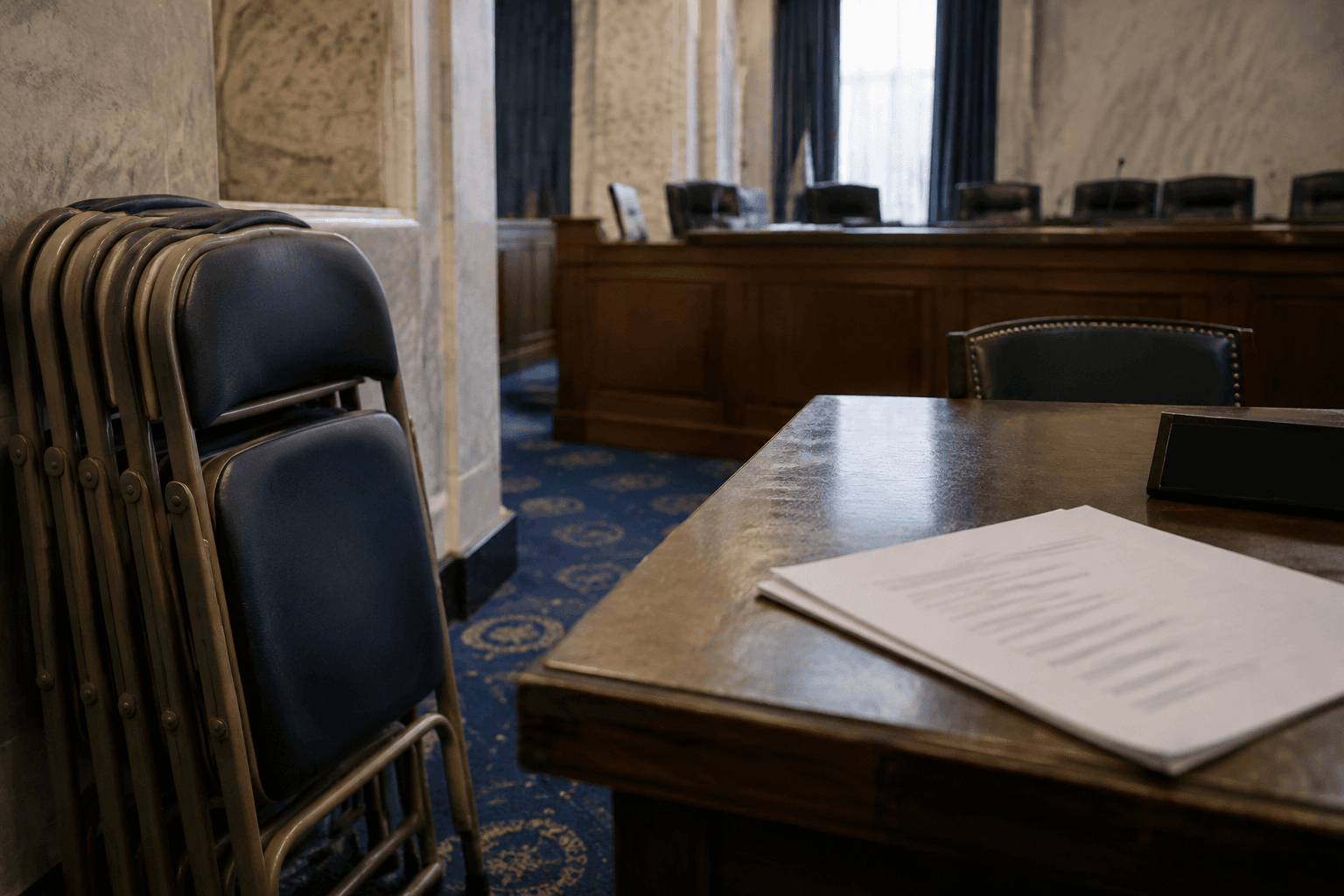
Stacked folding chairs beside a printed order-of-business sheet on a table in an empty committee room on Capitol Hill.
WORLD · ELECTIONS

Democrats' legislative agenda for the new Congress: healthcare, tariffs, and no third impeachment

After winning the 2026 midterms, Democrats led by Hakeem Jeffries and Chuck Schumer are laying out a legislative agenda built around ACA subsidies, Medicaid cuts and Trump's tariffs - while party leaders say a third impeachment of Trump is not on the table.

By LiveDigestPublished Sunday, November 8, 2026 · 12:25 GMT | 4 min read

Stacked folding chairs beside a printed order-of-business sheet on a table in an empty committee room on Capitol Hill.

Democrats won a monumental return to power in Tuesday's midterm elections, gaining new leverage over President Donald Trump after nearly two years of criticizing him over costs, chaos and corruption. With majorities in both chambers, the party's legislative agenda now centers on affordability measures, healthcare legislation and anti-corruption bills - and leaders are playing down the question of impeaching Trump a third time.

01 / ELECTIONS

Affordability bills to Trump's desk

Greg Casar, chair of the Congressional Progressive Caucus, said the party should pass legislation out of the House and Senate and force it to Trump's desk rather than let 2028 candidates be asked about plastic-straw bans. He listed bans on price gouging, Super Pacs and stock trading by lawmakers as priorities, arguing that any vetoed bills would become the platform for 2028 candidates and be signed into law in 2029.

Hakeem Jeffries, set to become House speaker when the new Congress convenes after the new year, framed the priorities as keeping a promise:

"We made a promise to the country that we would fight for an affordable America, and we intend to keep it"

Trump remains in the White House until January 2029 and can veto any bill that does not pass with overwhelming support. Chuck Schumer, expected to be the next Senate majority leader, said everything the party does maps onto three promises: lower costs, making government work for people, and cleaning up corruption.

02 / ELECTIONS

Healthcare at the center

Healthcare sits at the core of the agenda. Jeffries named reimplementing premium tax credits for Affordable Care Act plans and undoing the Republican-approved cuts to Medicaid as priorities, alongside action on Trump's tariffs and ending the conflict with Iran. Democrats' demands to extend the ACA subsidies triggered the record-long government shutdown last year, and their candidates highlighted the impending Medicaid cuts on the campaign trail.

Within the caucus, freshmen see the healthcare debate as an opportunity rather than a fight. Kristen McDonald Rivet, leading freshmen in the centrist New Democrat Coalition, said:

"It's actually an incredibly hopeful thing that we are going to debate what big thing we can do around healthcare."
  • Some members favor Medicare for all
  • Others are discussing Medicare for all who want it

McDonald Rivet said people want big change on healthcare and that she sees no combat within the caucus over approaches.

03 / ELECTIONS

Investigations replace impeachment

Impeaching Trump a third time does not appear to be on the table; Senate Republicans rescued the president after two impeachments during his first term. Jeffries said:

"I haven't had a single member of the House Democratic Caucus talk to me about impeachment."

Instead, oversight power will come through the committees. Robert Garcia, who will lead the House oversight panel, warned potential targets to lawyer up and flagged inquiries into allegations of corruption in Department of Homeland Security contracting, stock trading by lawmakers, corporate profiteering and the Jeffrey Epstein files.

Jamie Raskin, expected to lead the House judiciary committee, noted he had sent more than 200 demands for information to the Trump administration and others, telling reporters to go back and read his letters. Once Democrats take committee gavels next year, those requests can be backed by subpoenas; Raskin's earlier letters carried no legal force while he was in the minority.

04 / ELECTIONS

The limits of the majorities

The majorities are large but not unlimited. The Senate filibuster remains in place, letting Republicans block Democratic legislation without 60 votes. If Democrats win the two outstanding Senate races, Democrats and their allies will hold 56 seats, with ballot counting still ongoing.

Schumer acknowledged Trump can block efforts to lower costs and root out corruption, but predicted a political price:

"But if he does that, I have no doubt the American people will rebuke him and his party just like they did in the election."

Trump, who cannot run again in 2028, has oscillated between saying he would be willing to work with Democrats and posting an image of a red cap reading 'Veto'. One war powers resolution intended to end the conflict with Iran did pass the outgoing Congress, but the president has thus far ignored it.

The wins followed primaries that exposed divides between the party's left and center, including over aid to Israel, but faction leaders have taken tones of unity, helped by majorities expected to be so large that intraparty fights could be less impactful. Democrats take committee gavels and the House speaker's gavel when the new Congress convenes after the new year, with the two Senate races still being counted.


Stacked folding chairs beside a printed order-of-business sheet on a table in an empty committee room on Capitol Hill.
WORLD · ELECTIONS

Democrats' legislative agenda for the new Congress: healthcare, tariffs, and no third impeachment

After winning the 2026 midterms, Democrats led by Hakeem Jeffries and Chuck Schumer are laying out a legislative agenda built around ACA subsidies, Medicaid cuts and Trump's tariffs - while party leaders say a third impeachment of Trump is not on the table.

By LiveDigestPublished Sunday, November 8, 2026 · 12:25 GMT | 4 min read

Stacked folding chairs beside a printed order-of-business sheet on a table in an empty committee room on Capitol Hill.

Democrats won a monumental return to power in Tuesday's midterm elections, gaining new leverage over President Donald Trump after nearly two years of criticizing him over costs, chaos and corruption. With majorities in both chambers, the party's legislative agenda now centers on affordability measures, healthcare legislation and anti-corruption bills - and leaders are playing down the question of impeaching Trump a third time.

01 / ELECTIONS

Affordability bills to Trump's desk

Greg Casar, chair of the Congressional Progressive Caucus, said the party should pass legislation out of the House and Senate and force it to Trump's desk rather than let 2028 candidates be asked about plastic-straw bans. He listed bans on price gouging, Super Pacs and stock trading by lawmakers as priorities, arguing that any vetoed bills would become the platform for 2028 candidates and be signed into law in 2029.

Hakeem Jeffries, set to become House speaker when the new Congress convenes after the new year, framed the priorities as keeping a promise:

Trump remains in the White House until January 2029 and can veto any bill that does not pass with overwhelming support. Chuck Schumer, expected to be the next Senate majority leader, said everything the party does maps onto three promises: lower costs, making government work for people, and cleaning up corruption.

"We made a promise to the country that we would fight for an affordable America, and we intend to keep it"
02 / ELECTIONS

Healthcare at the center

Healthcare sits at the core of the agenda. Jeffries named reimplementing premium tax credits for Affordable Care Act plans and undoing the Republican-approved cuts to Medicaid as priorities, alongside action on Trump's tariffs and ending the conflict with Iran. Democrats' demands to extend the ACA subsidies triggered the record-long government shutdown last year, and their candidates highlighted the impending Medicaid cuts on the campaign trail.

Within the caucus, freshmen see the healthcare debate as an opportunity rather than a fight. Kristen McDonald Rivet, leading freshmen in the centrist New Democrat Coalition, said:

  • Some members favor Medicare for all
  • Others are discussing Medicare for all who want it

McDonald Rivet said people want big change on healthcare and that she sees no combat within the caucus over approaches.

"It's actually an incredibly hopeful thing that we are going to debate what big thing we can do around healthcare."
03 / ELECTIONS

Investigations replace impeachment

Impeaching Trump a third time does not appear to be on the table; Senate Republicans rescued the president after two impeachments during his first term. Jeffries said:

Instead, oversight power will come through the committees. Robert Garcia, who will lead the House oversight panel, warned potential targets to lawyer up and flagged inquiries into allegations of corruption in Department of Homeland Security contracting, stock trading by lawmakers, corporate profiteering and the Jeffrey Epstein files.

Jamie Raskin, expected to lead the House judiciary committee, noted he had sent more than 200 demands for information to the Trump administration and others, telling reporters to go back and read his letters. Once Democrats take committee gavels next year, those requests can be backed by subpoenas; Raskin's earlier letters carried no legal force while he was in the minority.

"I haven't had a single member of the House Democratic Caucus talk to me about impeachment."
04 / ELECTIONS

The limits of the majorities

The majorities are large but not unlimited. The Senate filibuster remains in place, letting Republicans block Democratic legislation without 60 votes. If Democrats win the two outstanding Senate races, Democrats and their allies will hold 56 seats, with ballot counting still ongoing.

Schumer acknowledged Trump can block efforts to lower costs and root out corruption, but predicted a political price:

Trump, who cannot run again in 2028, has oscillated between saying he would be willing to work with Democrats and posting an image of a red cap reading 'Veto'. One war powers resolution intended to end the conflict with Iran did pass the outgoing Congress, but the president has thus far ignored it.

The wins followed primaries that exposed divides between the party's left and center, including over aid to Israel, but faction leaders have taken tones of unity, helped by majorities expected to be so large that intraparty fights could be less impactful. Democrats take committee gavels and the House speaker's gavel when the new Congress convenes after the new year, with the two Senate races still being counted.

"But if he does that, I have no doubt the American people will rebuke him and his party just like they did in the election."
Stacked folding chairs beside a printed order-of-business sheet on a table in an empty committee room on Capitol Hill.
WORLD · ELECTIONS

Democrats' legislative agenda for the new Congress: healthcare, tariffs, and no third impeachment

By LiveDigest

Stacked folding chairs beside a printed order-of-business sheet on a table in an empty committee room on Capitol Hill.

Democrats won a monumental return to power in Tuesday's midterm elections, gaining new leverage over President Donald Trump after nearly two years of criticizing him over costs, chaos and corruption. With majorities in both chambers, the party's legislative agenda now centers on affordability measures, healthcare legislation and anti-corruption bills - and leaders are playing down the question of impeaching Trump a third time.

01 / ELECTIONS

Affordability bills to Trump's desk

Greg Casar, chair of the Congressional Progressive Caucus, said the party should pass legislation out of the House and Senate and force it to Trump's desk rather than let 2028 candidates be asked about plastic-straw bans. He listed bans on price gouging, Super Pacs and stock trading by lawmakers as priorities, arguing that any vetoed bills would become the platform for 2028 candidates and be signed into law in 2029.

Hakeem Jeffries, set to become House speaker when the new Congress convenes after the new year, framed the priorities as keeping a promise:

Trump remains in the White House until January 2029 and can veto any bill that does not pass with overwhelming support. Chuck Schumer, expected to be the next Senate majority leader, said everything the party does maps onto three promises: lower costs, making government work for people, and cleaning up corruption.

"We made a promise to the country that we would fight for an affordable America, and we intend to keep it"
02 / ELECTIONS

Healthcare at the center

Healthcare sits at the core of the agenda. Jeffries named reimplementing premium tax credits for Affordable Care Act plans and undoing the Republican-approved cuts to Medicaid as priorities, alongside action on Trump's tariffs and ending the conflict with Iran. Democrats' demands to extend the ACA subsidies triggered the record-long government shutdown last year, and their candidates highlighted the impending Medicaid cuts on the campaign trail.

Within the caucus, freshmen see the healthcare debate as an opportunity rather than a fight. Kristen McDonald Rivet, leading freshmen in the centrist New Democrat Coalition, said:

  • Some members favor Medicare for all
  • Others are discussing Medicare for all who want it

McDonald Rivet said people want big change on healthcare and that she sees no combat within the caucus over approaches.

"It's actually an incredibly hopeful thing that we are going to debate what big thing we can do around healthcare."
03 / ELECTIONS

Investigations replace impeachment

Impeaching Trump a third time does not appear to be on the table; Senate Republicans rescued the president after two impeachments during his first term. Jeffries said:

Instead, oversight power will come through the committees. Robert Garcia, who will lead the House oversight panel, warned potential targets to lawyer up and flagged inquiries into allegations of corruption in Department of Homeland Security contracting, stock trading by lawmakers, corporate profiteering and the Jeffrey Epstein files.

Jamie Raskin, expected to lead the House judiciary committee, noted he had sent more than 200 demands for information to the Trump administration and others, telling reporters to go back and read his letters. Once Democrats take committee gavels next year, those requests can be backed by subpoenas; Raskin's earlier letters carried no legal force while he was in the minority.

"I haven't had a single member of the House Democratic Caucus talk to me about impeachment."
04 / ELECTIONS

The limits of the majorities

The majorities are large but not unlimited. The Senate filibuster remains in place, letting Republicans block Democratic legislation without 60 votes. If Democrats win the two outstanding Senate races, Democrats and their allies will hold 56 seats, with ballot counting still ongoing.

Schumer acknowledged Trump can block efforts to lower costs and root out corruption, but predicted a political price:

Trump, who cannot run again in 2028, has oscillated between saying he would be willing to work with Democrats and posting an image of a red cap reading 'Veto'. One war powers resolution intended to end the conflict with Iran did pass the outgoing Congress, but the president has thus far ignored it.

The wins followed primaries that exposed divides between the party's left and center, including over aid to Israel, but faction leaders have taken tones of unity, helped by majorities expected to be so large that intraparty fights could be less impactful. Democrats take committee gavels and the House speaker's gavel when the new Congress convenes after the new year, with the two Senate races still being counted.

"But if he does that, I have no doubt the American people will rebuke him and his party just like they did in the election."