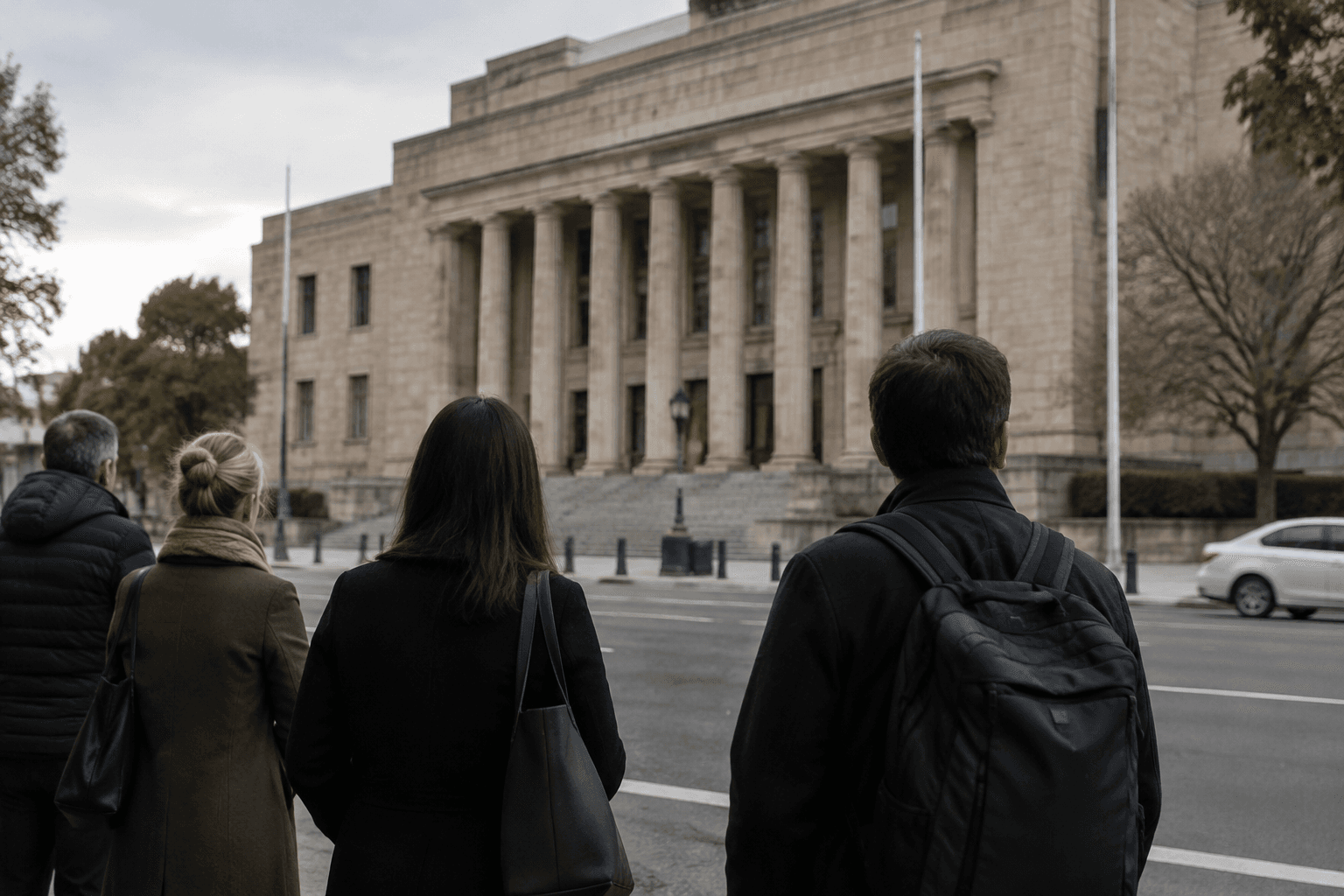
Federation-style stone facade of an Australian parliament building seen from behind a small group of people waiting on the footpath.
WORLD · SECURITY

Defence bill Australia: constitutional expert Anne Twomey calls secret security zone law 'lazy and irresponsible'

Constitutional law expert Prof Anne Twomey has branded Australia's new defence bill Australia passed this week 'lazy and irresponsible', warning its provisions for secret security rules raise serious rule of law issues.

By LiveDigestPublished Monday, November 23, 2026 · 08:38 GMT | 3 min read

Federation-style stone facade of an Australian parliament building seen from behind a small group of people waiting on the footpath.

A constitutional law expert has delivered a scathing assessment of the defence bill Australia rushed through parliament this week, calling it 'lazy and irresponsible' and warning that its secret security provisions put the rule of law at risk.

Prof Anne Twomey, professor emerita at the University of Sydney, criticised the 'accelerating capability and protecting bases' bill, which passed the lower house on Monday evening after clearing the Senate the previous week with little public scrutiny.

01 / SECURITY

What the bill allows

The new law creates offences around defence security zones. A person who enters such a zone, or photographs a zone or a person or thing within it, faces up to seven years' jail, a fine of $152,880, or both.

The zones are not limited to existing bases. They can also cover emergency, temporary or mobile sites decided by a minister, and the minister's powers within them are wide-ranging.

The bill also allows a minister to make a 'capability declaration':

  • permitting defence activity without contravening certain other laws, or changing how other laws apply, including state and territory laws
  • potentially held back from being declared as a legislative instrument
02 / SECURITY

Twomey's warning

Twomey said the prospect of secret alterations to commonwealth, state and territory laws was 'a really serious development', and that secret declarations raised 'serious rule of law issues'.

She warned of an increasing trend of ministers exercising discretionary powers without parliamentary oversight, saying parliament had effectively given up and handed power to the minister, senior public servants or defence officers to exclude the application of existing laws to defence activities. The powers, she said, risk being misused in the future.

On the tension between flexibility and democracy, she said:

"we're trying to defend our democratic system of government, and we don't want to throw it out at the same time"
03 / SECURITY

Government and crossbench response

Prime minister Anthony Albanese, in his first public comments on the legislation, said on Monday that critics were 'jump[ing] at shadows' and making 'absurd' claims. The powers were necessary and 'just practical', he said, adding that "we live in unsafe times" and that there are more conflicts in the world today than at any time since World War II.

Labor and the Coalition backed the bill, with only a handful of crossbenchers - including Kate Chaney, Monique Ryan and Andrew Wilkie - resisting it. The Greens, David Pocock, Digital Rights Watch and other civil society groups strongly opposed the bill.

Greens leader David Shoebridge called the changes 'extreme wartime powers' and 'an assault on civil liberties', claiming people may be charged for breaking laws they were not even aware of. Pocock called Albanese's response 'disingenuous' and said that "At a bare minimum, far stronger safeguards are needed around the use of ministerial powers".

04 / SECURITY

How the bill passed

Twomey, in a video on her YouTube channel, said it was 'flabbergasting that it was not the subject of proper debate or scrutiny before this law was enacted'. The bill has now passed both houses of parliament, with calls from Pocock and others for stronger safeguards standing as the current state of debate.
Federation-style stone facade of an Australian parliament building seen from behind a small group of people waiting on the footpath.
WORLD · SECURITY

Defence bill Australia: constitutional expert Anne Twomey calls secret security zone law 'lazy and irresponsible'

Constitutional law expert Prof Anne Twomey has branded Australia's new defence bill Australia passed this week 'lazy and irresponsible', warning its provisions for secret security rules raise serious rule of law issues.

By LiveDigestPublished Monday, November 23, 2026 · 08:38 GMT | 3 min read

Federation-style stone facade of an Australian parliament building seen from behind a small group of people waiting on the footpath.

A constitutional law expert has delivered a scathing assessment of the defence bill Australia rushed through parliament this week, calling it 'lazy and irresponsible' and warning that its secret security provisions put the rule of law at risk.

Prof Anne Twomey, professor emerita at the University of Sydney, criticised the 'accelerating capability and protecting bases' bill, which passed the lower house on Monday evening after clearing the Senate the previous week with little public scrutiny.

01 / SECURITY

What the bill allows

The new law creates offences around defence security zones. A person who enters such a zone, or photographs a zone or a person or thing within it, faces up to seven years' jail, a fine of $152,880, or both.

The zones are not limited to existing bases. They can also cover emergency, temporary or mobile sites decided by a minister, and the minister's powers within them are wide-ranging.

The bill also allows a minister to make a 'capability declaration':

  • permitting defence activity without contravening certain other laws, or changing how other laws apply, including state and territory laws
  • potentially held back from being declared as a legislative instrument
02 / SECURITY

Twomey's warning

Twomey said the prospect of secret alterations to commonwealth, state and territory laws was 'a really serious development', and that secret declarations raised 'serious rule of law issues'.

She warned of an increasing trend of ministers exercising discretionary powers without parliamentary oversight, saying parliament had effectively given up and handed power to the minister, senior public servants or defence officers to exclude the application of existing laws to defence activities. The powers, she said, risk being misused in the future.

On the tension between flexibility and democracy, she said:

"we're trying to defend our democratic system of government, and we don't want to throw it out at the same time"
03 / SECURITY

Government and crossbench response

Prime minister Anthony Albanese, in his first public comments on the legislation, said on Monday that critics were 'jump[ing] at shadows' and making 'absurd' claims. The powers were necessary and 'just practical', he said, adding that "we live in unsafe times" and that there are more conflicts in the world today than at any time since World War II.

Labor and the Coalition backed the bill, with only a handful of crossbenchers - including Kate Chaney, Monique Ryan and Andrew Wilkie - resisting it. The Greens, David Pocock, Digital Rights Watch and other civil society groups strongly opposed the bill.

Greens leader David Shoebridge called the changes 'extreme wartime powers' and 'an assault on civil liberties', claiming people may be charged for breaking laws they were not even aware of. Pocock called Albanese's response 'disingenuous' and said that "At a bare minimum, far stronger safeguards are needed around the use of ministerial powers".

04 / SECURITY

How the bill passed

Twomey, in a video on her YouTube channel, said it was 'flabbergasting that it was not the subject of proper debate or scrutiny before this law was enacted'. The bill has now passed both houses of parliament, with calls from Pocock and others for stronger safeguards standing as the current state of debate.

Federation-style stone facade of an Australian parliament building seen from behind a small group of people waiting on the footpath.
WORLD · SECURITY

Defence bill Australia: constitutional expert Anne Twomey calls secret security zone law 'lazy and irresponsible'

By LiveDigest

Federation-style stone facade of an Australian parliament building seen from behind a small group of people waiting on the footpath.

A constitutional law expert has delivered a scathing assessment of the defence bill Australia rushed through parliament this week, calling it 'lazy and irresponsible' and warning that its secret security provisions put the rule of law at risk.

Prof Anne Twomey, professor emerita at the University of Sydney, criticised the 'accelerating capability and protecting bases' bill, which passed the lower house on Monday evening after clearing the Senate the previous week with little public scrutiny.

01 / SECURITY

What the bill allows

The new law creates offences around defence security zones. A person who enters such a zone, or photographs a zone or a person or thing within it, faces up to seven years' jail, a fine of $152,880, or both.

The zones are not limited to existing bases. They can also cover emergency, temporary or mobile sites decided by a minister, and the minister's powers within them are wide-ranging.

The bill also allows a minister to make a 'capability declaration':

  • permitting defence activity without contravening certain other laws, or changing how other laws apply, including state and territory laws
  • potentially held back from being declared as a legislative instrument
02 / SECURITY

Twomey's warning

Twomey said the prospect of secret alterations to commonwealth, state and territory laws was 'a really serious development', and that secret declarations raised 'serious rule of law issues'.

She warned of an increasing trend of ministers exercising discretionary powers without parliamentary oversight, saying parliament had effectively given up and handed power to the minister, senior public servants or defence officers to exclude the application of existing laws to defence activities. The powers, she said, risk being misused in the future.

On the tension between flexibility and democracy, she said:

"we're trying to defend our democratic system of government, and we don't want to throw it out at the same time"
03 / SECURITY

Government and crossbench response

Prime minister Anthony Albanese, in his first public comments on the legislation, said on Monday that critics were 'jump[ing] at shadows' and making 'absurd' claims. The powers were necessary and 'just practical', he said, adding that "we live in unsafe times" and that there are more conflicts in the world today than at any time since World War II.

Labor and the Coalition backed the bill, with only a handful of crossbenchers - including Kate Chaney, Monique Ryan and Andrew Wilkie - resisting it. The Greens, David Pocock, Digital Rights Watch and other civil society groups strongly opposed the bill.

Greens leader David Shoebridge called the changes 'extreme wartime powers' and 'an assault on civil liberties', claiming people may be charged for breaking laws they were not even aware of. Pocock called Albanese's response 'disingenuous' and said that "At a bare minimum, far stronger safeguards are needed around the use of ministerial powers".

04 / SECURITY

How the bill passed

Twomey, in a video on her YouTube channel, said it was 'flabbergasting that it was not the subject of proper debate or scrutiny before this law was enacted'. The bill has now passed both houses of parliament, with calls from Pocock and others for stronger safeguards standing as the current state of debate.