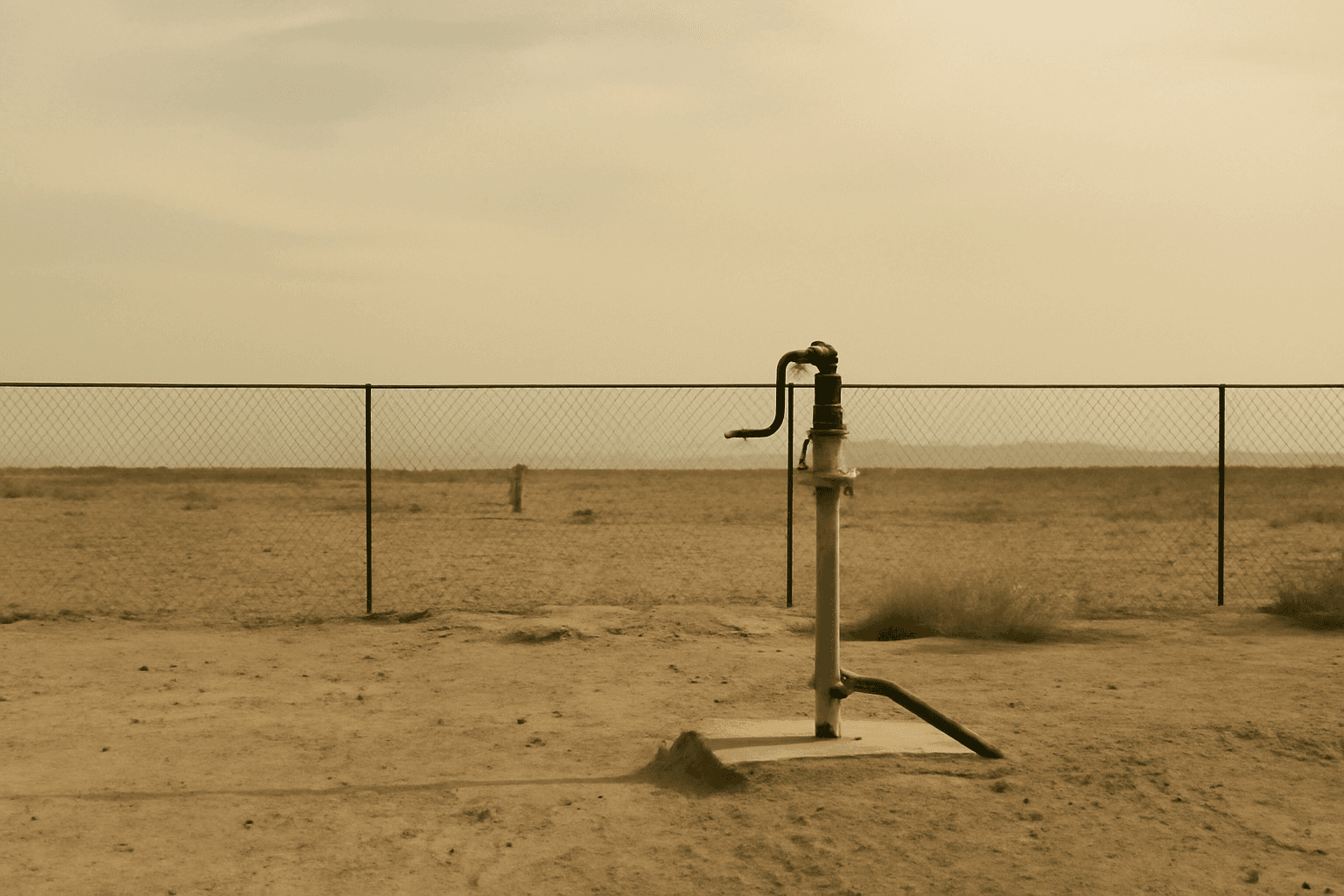
A dry desert lot in Imperial County with a lone water pump standing beside a chain-link fence under a hazy afternoon sky.
WORLD · ENVIRONMENT

Lawyer's AI datacenter California plan stalls after county judge orders environmental review

A county judge has paused Sebastian Rucci's plan to build the largest AI datacenter in California on desert land in Imperial county, ruling last month that the project cannot move forward until it completes an extensive environmental review.

By LiveDigestPublished Saturday, October 17, 2026 · 13:15 GMT | 5 min read

A dry desert lot in Imperial County with a lone water pump standing beside a chain-link fence under a hazy afternoon sky.

The ruling puts on hold a proposal that has divided a small desert community for the past year. The project's developer, a 66-year-old lawyer named Sebastian Rucci, had spent months promoting the facility to county agencies as a transformative investment - and had told them Google was interested in moving in.

01 / ENVIRONMENT

A nearly 1m-square-foot plan in the desert

In late 2024, Rucci identified a plot in Imperial county as the place to realize what he called his dream of building the largest AI datacenter in California. The site sits in the Sonoran desert just north of the Mexican border, where temperatures regularly rise past 100F (37.8C). Water there is scarce: the once-booming agricultural area draws its supply from the beleaguered Colorado River.

  • Rucci began plotting a nearly 1m-square-foot facility - the size of 16 football fields combined - last year, with union support.
  • He worked with the local energy provider to eventually secure 330 megawatts of electricity, enough to power a city the size of Tallahassee.
  • His application to the county planning department includes an electrical substation, on-site battery energy storage and more than 130 methane-gas-fueled generators.
  • Rucci says the facility will bring more than 1,600 construction jobs and nearly $30m in annual tax revenue.

The project's umbrella company is an LLC called Imperial Valley Computer Manufacturing (IVCM), one of several new businesses Rucci registered for it. He has said he invested about $5m already.

Rucci, who is based in Huntington Beach, has started businesses across southern California, St Louis and Ohio. He admitted he initially knew little about datacenters, until calls to Silicon Valley contacts showed him the scale of the business.

02 / ENVIRONMENT

Claims of Google interest, and Google's answer

According to emails between Rucci and county agencies, Rucci said his sales skills won him a direct line to Google, which floated interest in being the datacenter's tenant. In a July email to Imperial county's planning and development services, he wrote the datacenter would "enable Google to conduct artificial intelligence and large language model training for its Gemini system".

In an August email to the county's air pollution control district, he wrote: "We have secured interest from Google for this project, which we are confident will transform the area through increased tax revenues, new employment opportunities, and expanded energy production."

We are not involved in a datacenter project in Imperial county

That was the response from a Google spokesperson, who did not answer questions about the company's relationship with Rucci. Rucci said the company's answer made sense considering the two do not have a formal agreement.

03 / ENVIRONMENT

Residents push back

Francisco Leal, who lives across the street from the proposed site, learned of it the day before Thanksgiving last year, when a flyer hung on his door mapped the project onto the 75 acres opposite his home and warned construction would proceed without the state's usual environmental review. His back fence is all that separates his house in the city of Imperial from the site, which sits just outside city limits on unincorporated county land.

Leal has become one of the voices of the opposition. "This project was presented as a Noah's Ark that's going to come save everybody. But the community sees this project as a Trojan horse," he said.

Over the past year, more than half a dozen lawsuits have been filed against the project, alongside recall efforts against supportive local officials and a temporary 45-day datacenter moratorium. Within months, close to 3,500 people signed a petition opposing the facility, and state senator Steve Padilla introduced a series of bills aimed at datacenters.

The fears residents have raised are concrete. They worry about increased emissions, harm to rare desert wildlife, strain on the power grid, a dwindling water supply and noise; Rucci denies the project will have such effects.

Imperial county is critical habitat for the endangered desert pupfish, which swims through agricultural drains and canals, including one crossing Rucci's property; the flat-tailed horned lizard, yellow-breasted chat and burrowing owls are also species of concern. Christopher Scurries, a music teacher at Imperial high school who lives nearby, said the constant low hum was a concern: "I'll definitely hear when I'm here in my house."

04 / ENVIRONMENT

What happens next

The land is zoned for industrial use, which would have let Rucci apply for an exemption from the California Environmental Quality Act (CEQA) and skip the environmental permitting process. That path is now blocked: Rucci's developments are on pause after a county judge ruled last month that the project cannot move forward until it clears an extensive environmental review.

The delay matters in a market moving fast elsewhere. Michael Thomas, founder of Cleanview, said major datacenter projects in California take an average of seven years to complete, versus about three years in Texas. He added that land and power have become so scarce at the scale big tech companies need that a developer who shortens the timeline could be paid a huge premium by companies like Google, Microsoft or Meta, potentially making millions quickly. For now, the Imperial county plan waits on the review the judge required.

A dry desert lot in Imperial County with a lone water pump standing beside a chain-link fence under a hazy afternoon sky.
WORLD · ENVIRONMENT

Lawyer's AI datacenter California plan stalls after county judge orders environmental review

A county judge has paused Sebastian Rucci's plan to build the largest AI datacenter in California on desert land in Imperial county, ruling last month that the project cannot move forward until it completes an extensive environmental review.

By LiveDigestPublished Saturday, October 17, 2026 · 13:15 GMT | 5 min read

A dry desert lot in Imperial County with a lone water pump standing beside a chain-link fence under a hazy afternoon sky.

The ruling puts on hold a proposal that has divided a small desert community for the past year. The project's developer, a 66-year-old lawyer named Sebastian Rucci, had spent months promoting the facility to county agencies as a transformative investment - and had told them Google was interested in moving in.

01 / ENVIRONMENT

A nearly 1m-square-foot plan in the desert

In late 2024, Rucci identified a plot in Imperial county as the place to realize what he called his dream of building the largest AI datacenter in California. The site sits in the Sonoran desert just north of the Mexican border, where temperatures regularly rise past 100F (37.8C). Water there is scarce: the once-booming agricultural area draws its supply from the beleaguered Colorado River.

  • Rucci began plotting a nearly 1m-square-foot facility - the size of 16 football fields combined - last year, with union support.
  • He worked with the local energy provider to eventually secure 330 megawatts of electricity, enough to power a city the size of Tallahassee.
  • His application to the county planning department includes an electrical substation, on-site battery energy storage and more than 130 methane-gas-fueled generators.
  • Rucci says the facility will bring more than 1,600 construction jobs and nearly $30m in annual tax revenue.

The project's umbrella company is an LLC called Imperial Valley Computer Manufacturing (IVCM), one of several new businesses Rucci registered for it. He has said he invested about $5m already.

Rucci, who is based in Huntington Beach, has started businesses across southern California, St Louis and Ohio. He admitted he initially knew little about datacenters, until calls to Silicon Valley contacts showed him the scale of the business.

02 / ENVIRONMENT

Claims of Google interest, and Google's answer

According to emails between Rucci and county agencies, Rucci said his sales skills won him a direct line to Google, which floated interest in being the datacenter's tenant. In a July email to Imperial county's planning and development services, he wrote the datacenter would "enable Google to conduct artificial intelligence and large language model training for its Gemini system".

In an August email to the county's air pollution control district, he wrote: "We have secured interest from Google for this project, which we are confident will transform the area through increased tax revenues, new employment opportunities, and expanded energy production."

That was the response from a Google spokesperson, who did not answer questions about the company's relationship with Rucci. Rucci said the company's answer made sense considering the two do not have a formal agreement.

We are not involved in a datacenter project in Imperial county
03 / ENVIRONMENT

Residents push back

Francisco Leal, who lives across the street from the proposed site, learned of it the day before Thanksgiving last year, when a flyer hung on his door mapped the project onto the 75 acres opposite his home and warned construction would proceed without the state's usual environmental review. His back fence is all that separates his house in the city of Imperial from the site, which sits just outside city limits on unincorporated county land.

Leal has become one of the voices of the opposition. "This project was presented as a Noah's Ark that's going to come save everybody. But the community sees this project as a Trojan horse," he said.

Over the past year, more than half a dozen lawsuits have been filed against the project, alongside recall efforts against supportive local officials and a temporary 45-day datacenter moratorium. Within months, close to 3,500 people signed a petition opposing the facility, and state senator Steve Padilla introduced a series of bills aimed at datacenters.

The fears residents have raised are concrete. They worry about increased emissions, harm to rare desert wildlife, strain on the power grid, a dwindling water supply and noise; Rucci denies the project will have such effects.

Imperial county is critical habitat for the endangered desert pupfish, which swims through agricultural drains and canals, including one crossing Rucci's property; the flat-tailed horned lizard, yellow-breasted chat and burrowing owls are also species of concern. Christopher Scurries, a music teacher at Imperial high school who lives nearby, said the constant low hum was a concern: "I'll definitely hear when I'm here in my house."

04 / ENVIRONMENT

What happens next

The land is zoned for industrial use, which would have let Rucci apply for an exemption from the California Environmental Quality Act (CEQA) and skip the environmental permitting process. That path is now blocked: Rucci's developments are on pause after a county judge ruled last month that the project cannot move forward until it clears an extensive environmental review.

The delay matters in a market moving fast elsewhere. Michael Thomas, founder of Cleanview, said major datacenter projects in California take an average of seven years to complete, versus about three years in Texas. He added that land and power have become so scarce at the scale big tech companies need that a developer who shortens the timeline could be paid a huge premium by companies like Google, Microsoft or Meta, potentially making millions quickly. For now, the Imperial county plan waits on the review the judge required.
A dry desert lot in Imperial County with a lone water pump standing beside a chain-link fence under a hazy afternoon sky.
WORLD · ENVIRONMENT

Lawyer's AI datacenter California plan stalls after county judge orders environmental review

By LiveDigest

A dry desert lot in Imperial County with a lone water pump standing beside a chain-link fence under a hazy afternoon sky.

The ruling puts on hold a proposal that has divided a small desert community for the past year. The project's developer, a 66-year-old lawyer named Sebastian Rucci, had spent months promoting the facility to county agencies as a transformative investment - and had told them Google was interested in moving in.

01 / ENVIRONMENT

A nearly 1m-square-foot plan in the desert

In late 2024, Rucci identified a plot in Imperial county as the place to realize what he called his dream of building the largest AI datacenter in California. The site sits in the Sonoran desert just north of the Mexican border, where temperatures regularly rise past 100F (37.8C). Water there is scarce: the once-booming agricultural area draws its supply from the beleaguered Colorado River.

  • Rucci began plotting a nearly 1m-square-foot facility - the size of 16 football fields combined - last year, with union support.
  • He worked with the local energy provider to eventually secure 330 megawatts of electricity, enough to power a city the size of Tallahassee.
  • His application to the county planning department includes an electrical substation, on-site battery energy storage and more than 130 methane-gas-fueled generators.
  • Rucci says the facility will bring more than 1,600 construction jobs and nearly $30m in annual tax revenue.

The project's umbrella company is an LLC called Imperial Valley Computer Manufacturing (IVCM), one of several new businesses Rucci registered for it. He has said he invested about $5m already.

Rucci, who is based in Huntington Beach, has started businesses across southern California, St Louis and Ohio. He admitted he initially knew little about datacenters, until calls to Silicon Valley contacts showed him the scale of the business.

02 / ENVIRONMENT

Claims of Google interest, and Google's answer

According to emails between Rucci and county agencies, Rucci said his sales skills won him a direct line to Google, which floated interest in being the datacenter's tenant. In a July email to Imperial county's planning and development services, he wrote the datacenter would "enable Google to conduct artificial intelligence and large language model training for its Gemini system".

In an August email to the county's air pollution control district, he wrote: "We have secured interest from Google for this project, which we are confident will transform the area through increased tax revenues, new employment opportunities, and expanded energy production."

That was the response from a Google spokesperson, who did not answer questions about the company's relationship with Rucci. Rucci said the company's answer made sense considering the two do not have a formal agreement.

We are not involved in a datacenter project in Imperial county
03 / ENVIRONMENT

Residents push back

Francisco Leal, who lives across the street from the proposed site, learned of it the day before Thanksgiving last year, when a flyer hung on his door mapped the project onto the 75 acres opposite his home and warned construction would proceed without the state's usual environmental review. His back fence is all that separates his house in the city of Imperial from the site, which sits just outside city limits on unincorporated county land.

Leal has become one of the voices of the opposition. "This project was presented as a Noah's Ark that's going to come save everybody. But the community sees this project as a Trojan horse," he said.

Over the past year, more than half a dozen lawsuits have been filed against the project, alongside recall efforts against supportive local officials and a temporary 45-day datacenter moratorium. Within months, close to 3,500 people signed a petition opposing the facility, and state senator Steve Padilla introduced a series of bills aimed at datacenters.

The fears residents have raised are concrete. They worry about increased emissions, harm to rare desert wildlife, strain on the power grid, a dwindling water supply and noise; Rucci denies the project will have such effects.

Imperial county is critical habitat for the endangered desert pupfish, which swims through agricultural drains and canals, including one crossing Rucci's property; the flat-tailed horned lizard, yellow-breasted chat and burrowing owls are also species of concern. Christopher Scurries, a music teacher at Imperial high school who lives nearby, said the constant low hum was a concern: "I'll definitely hear when I'm here in my house."

04 / ENVIRONMENT

What happens next

The land is zoned for industrial use, which would have let Rucci apply for an exemption from the California Environmental Quality Act (CEQA) and skip the environmental permitting process. That path is now blocked: Rucci's developments are on pause after a county judge ruled last month that the project cannot move forward until it clears an extensive environmental review.

The delay matters in a market moving fast elsewhere. Michael Thomas, founder of Cleanview, said major datacenter projects in California take an average of seven years to complete, versus about three years in Texas. He added that land and power have become so scarce at the scale big tech companies need that a developer who shortens the timeline could be paid a huge premium by companies like Google, Microsoft or Meta, potentially making millions quickly. For now, the Imperial county plan waits on the review the judge required.