Bronze leg roman statue find in Scotland reframed as part of Antoninus Pius horseman
A gilded bronze leg roman statue fragment unearthed in a Scottish bog in 1820 is now believed to have belonged to a vast statue of emperor Antoninus Pius on horseback erected near Hawick, according to archaeologists. It is the centrepiece of Roman Scotland: Life on the Edge of Empire, opening Saturday at the National Museum of Scotland in Edinburgh.
Bronze leg roman statue find in Scotland reframed as part of Antoninus Pius horseman
From charter room to centrepiece
The gilded bronze fragment, known as the Mislington leg, spent 100 years in the charter room at Dalkeith House near Edinburgh, owned by the Duke of Buccleuch, after being dug up in 1820. Archaeologists now believe it came from the Scottish Borders and formed part of a huge statue of the emperor Antoninus Pius on horseback, raised near Hawick after his armies took control of southern Scotland in about AD140.
That reading overturns a long-standing account. Antiquarians had argued the leg was looted, perhaps from York, hacked off by Scottish tribes and carried north over Hadrian's Wall. As early as 1932 the scholar James Curle doubted a statue could have stood so far north:
We cannot visualise the conditions which would have led to its erection anywhere north of the Great Wall.
The leg is now the centrepiece of the largest exhibition ever staged on the Romans in Scotland.
A careful removal, not a hack job
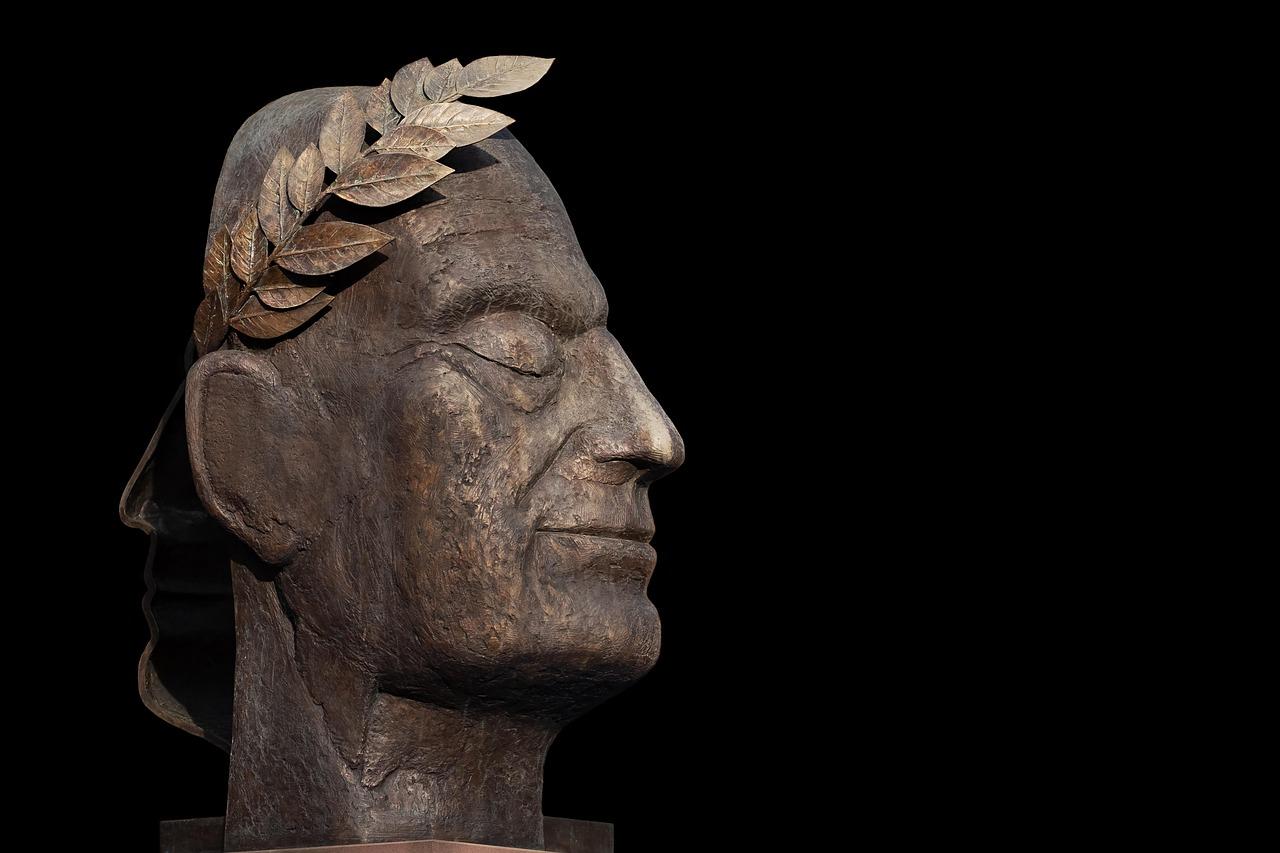
Dr Fraser Hunter, principal curator of the exhibition, believes the leg was not hacked off but carefully removed and deposited where it was found, 1,700 years later. Statues of this kind, he said, would have looked utterly foreign to local communities.
The whole idea of depicting a person is absolutely alien to the iron-age worldview.
Inveresk: a centre of imperial power
The exhibition also gathers finds from Inveresk, east of Edinburgh, the site of a large Roman fort and town that Hunter sees as a centre of imperial power during the Antonine period of AD142 to 165. They include:
- A new reconstruction of a heavily decorated earthenware bowl from Inveresk, whose combination of animal reliefs - dolphins, stags and a stylised hunting dog - is, according to assistant curator Bethany Simpson, unique.
- Two remarkably well preserved, locally carved stone altars from a mithraeum at Inveresk, shown for the first time, with lighting that reveals their original painted colours. One has slits cut into its hollowed-out stone radiating from the carved head of Mithras, with holes in its eyes and mouth so lamplight could shine out through the temple's smoky darkness.
- The entire skeleton of a horse carefully buried at Inveresk, a town that also had a small amphitheatre, a rare feature in frontier settlements.
Simpson said of the bowl's style that it appears nowhere else in the country or beyond: "You only find it in Inveresk. It's not seen anywhere else in Scotland; it's not seen anywhere in the UK." Of the horse burial, Hunter said: "The burial of cavalry horses in Britain is rare. Normally they just get disposed of, so this must have been a valued steed, which is really interesting."
Rome's northern legacy
The garrison Hunter envisages numbers about 10,000 troops, with auxiliaries drawn from regions as distant as modern-day Romania and north Africa, spread across southern and eastern Scotland - and perhaps another 10,000 camp followers, wives and enslaved people travelled with them. Recent scholarship suggests pre-Roman Scotland had no tradition of carving, yet the occupation gave rise to rich native styles that culminated in ornate Pictish standing stones.
Celtic rulers found Roman silver irresistible, and the Romans spent it to secure loyalty. By the third and fourth centuries the Roman threat had pushed Pictish tribes into an "anti-Roman coalition". Hunter argues the occupation ultimately strengthened its opponents: "What Roman interventions effectively do is they create a worse enemy. It's the problem that empires often have in dabbling around their edges." Larger-scale polities emerged using Rome as a model, he said, and the emergence of the Pictish symbols was tied to local exposure to sculpture and writing.
Roman Scotland: Life on the Edge of Empire opens on Saturday at the National Museum of Scotland in Edinburgh.